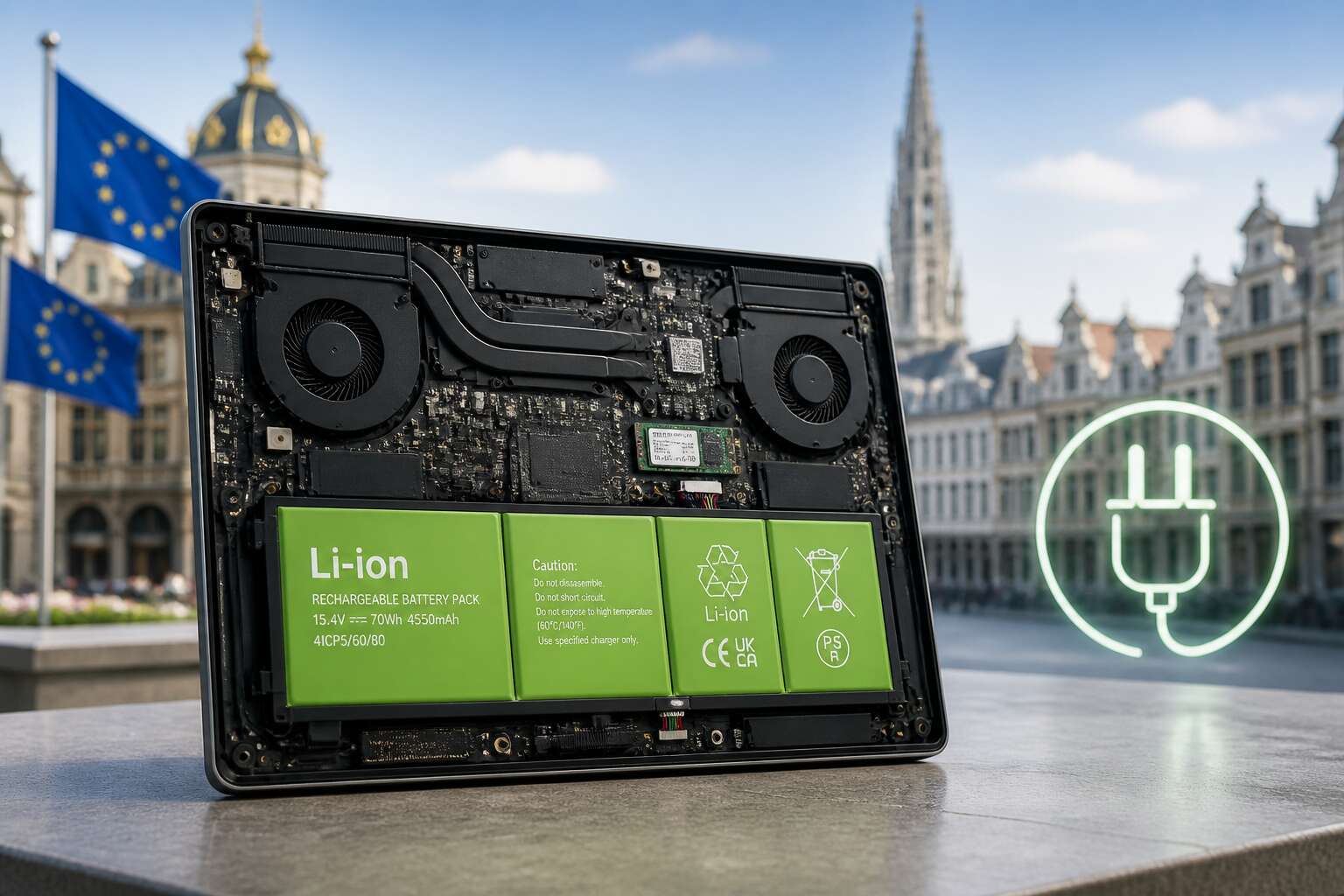
Understanding Laptop Battery Types and Compatibility
Common Chemistries: Li-ion, Li-Po, and NiMH
Inside every laptop battery lies a chemistry lesson your high school teacher would love, but for all the wrong reasons. Li-ion, Li-Po, and NiMH each behave like moody colleagues: reliable one day, explosive the next. When you hunt for laptop batteries europe, you are not buying a brand. You are buying a compatibility contract.
- Li-ion: the standard, high energy density, but sensitive to heat
- Li-Po: flexible and lightweight, often glued into thin ultrabooks
- NiMH: rare these days, heavier, and prone to memory effects
Matching the correct chemistry is nonnegotiable. A Li-Po pack will not forgive you for forcing a Li-ion connector. Meanwhile, European regulations push for easier swaps, which means you can actually replace these cells without a soldering iron. Just check the voltage and pinout first. Otherwise you will learn what the term “unplanned disassembly” means.
Voltage and Capacity Ratings Explained
Voltage dictates whether your machine wakes or refuses to power on. Capacity, measured in watt hours, determines how long you roam unplugged. Mismatched voltage can damage the board, while a lower capacity shortens your session.
When I source laptop batteries europe, I cross reference the original part number first. A 10.8V pack will not replace an 11.1V unit without consequences. European replacement standards often list both values, but your motherboard cares only about the exact figure.
Check the pinout too. Positive and negative terminals may look identical yet carry different roles. Some batteries include a third sense wire for temperature. Ignore it and you may trigger a shutdown.
How to Choose a Compatible Replacement
Nearly half of all replacement laptop batteries fail the compatibility test before they fail electrically. The culprit is rarely the cell chemistry. It is the system management controller, a small processor that demands a precise handshake with the battery’s own chip.
When I source laptop batteries europe, I look for the exact part number, then I check the firmware version. A battery built for an older BIOS will be ignored by a newer one. The physical shape and the connector are the first requirement. The second requirement is the encrypted communication between the battery and the motherboard. South African users on the second-hand market often face this issue with imported machines.
- Match the manufacturer and part number exactly.
- Confirm the battery’s firmware is compatible with your BIOS date.
- Test the battery in the identical laptop model before a long trip.
This process saves money but also saves the embarrassment of a dead machine in a meeting.
OEM vs. Aftermarket Batteries: Pros and Cons
Forty percent of aftermarket battery failures in Cape Town turn out to be compatibility errors, not dead cells. OEM batteries require a matching serial number and a firmware handshake. Aftermarket brands offer the same voltage at half the price, but the system management controller often disagrees.
When I source laptop batteries europe, I see a pattern. European OEM stocks are tightly controlled, while aftermarket units appear with identical labels. The real difference is the battery management system. OEM units use proprietary protocols; aftermarket ones use a generic handshake that works until the next firmware patch.
- OEM batteries cost more but run cooler.
- Aftermarket batteries save money but lose calibration.
- Genuine units carry a real warranty; clones disappear.
For South Africans, the aftermarket route tempts, yet a dead battery during load-shedding is a serious problem. Match the part number exactly, whether buying locally or shipping laptop batteries europe.
Navigating European Regulations and Standards
EU Battery Directive and CE Marking Requirements
The 2023 EU Battery Regulation recast is not a mundane compliance issue. It is a fundamental force reshaping the entire supply chain for laptop batteries europe. For South African businesses importing these components, this regulation functions as a gatekeeper. The primary legislative act, Directive 2006/66/EC, has been significantly revised, introducing stringent requirements for carbon footprint declarations, recycled content, and digital battery passports. These demands directly influence which products you can legally stock and sell.
For the consumer, the CE mark on a replacement cell is your passport to safety and performance assurance. This marking is not merely a sticker. It is a legal declaration that the manufacturer has met all relevant harmonised standards for electromagnetic compatibility and low voltage directives. The process involves robust testing and rigorous documentation.
To achieve and maintain compliance, suppliers must focus on several key elements:
– Traceable material sourcing
– Certified laboratory test reports
– Registered producer responsibility schemes
– Provision of detailed technical documentation
Navigating these requirements offers a competitive advantage. A verified CE mark ensures a product performs reliably under local South African conditions without causing interference with other devices. While the road to full compliance is complex, it provides a clear path to identifying high quality versus substandard parts. As a buyer, you must verify that your sourced laptop batteries europe come with a valid CE certificate and not just a printed logo. This single check saves you from the costly pitfalls of imported goods that fail early or, worse, pose a fire hazard. The European standard has effectively become the global benchmark for quality assurance.
Waste Electrical and Electronic Equipment (WEEE) Rules
The WEEE Directive adds another layer to the responsible handling of laptop batteries europe. Once a battery completes its lifecycle, the producer must finance its collection and recycling. For South African importers, this shifts the conversation from purchase price to end of life accountability.
A compliant supplier participates in registered take-back schemes. You should verify:
- Registration with a recognised producer compliance scheme
- Documentation of recycling pathways
- Proof of financing for collection and recovery
Without this traceability, a shipment of laptop batteries europe can become a liability. European rules demand that hazardous components never reach landfill. The process feels administrative, yet the responsibility is real and it protects the environment and your reputation. I have seen buyers overlook WEEE paperwork only to face customs delays. That is a cost no margin can absorb!
Shipping and Transport Restrictions for Lithium Batteries
A single missing label can ground an entire air freight consignment for weeks. The UN Manual of Tests and Criteria mandates specific packaging and labelling for every shipment of laptop batteries europe, and carriers enforce these rules with little room for error. For South African importers, the phrase carries hidden freight costs when documentation misses one marking.
Consider the practical checklist before dispatch:
- State of charge limits for air freight, often 30 percent
- Overpack markings and lithium battery handling labels
- Transport documentation signed by a trained person
I have watched shipments stall for weeks over a missing UN3480 label. The regulations change frequently, and customs officials do not care about your margin!
Import Duties and VAT When Buying Across Borders
When sourcing laptop batteries europe from South Africa, the price on screen rarely reflects the final cost. Import duties and VAT transform that bargain into a calculated investment.
Customs duties depend on the Harmonized System code assigned to lithium cells, and the South African Revenue Service applies VAT of 15% to the sum of the product, freight, and insurance. Trust me, that surprise only appears when the shipment clears customs.
- Seller VAT status determines whether EU VAT is deducted at source
- HS code classification sets the duty rate applied at the border
- Freight and insurance become part of the VAT taxable base
Each factor quietly separates the quoted price from the delivered true cost.
Where to Buy Replacement Laptop Batteries Across Europe
Trusted Online Marketplaces and Specialized Retailers
Every year, thousands of laptop batteries europe orders end up being low-grade spares. Genuine cells get swapped before dispatch, and the problem only surfaces after a few charge cycles. So where do you buy with confidence?
Trusted online marketplaces like Amazon Germany and eBay remain the default, provided you filter by seller history. Specialized retailers such as Green Cell, Batemax, and XTPA manufacture or source directly, offering warranties that marketplace resellers rarely match.
- Amazon.de and eBay with seller ratings above 95 percent
- Green Cell and Batemax for direct manufacturer support
- Approved distributors listed on laptop maker support pages
Check that the seller operates from an actual EU warehouse. That ensures faster replacements and a clean record of origin. Sellers who refuse to confirm CE compliance should be avoided. In the laptop batteries europe market, the right vendor makes all the difference.
Authorized Service Centers vs. Independent Shops
Walking into an authorized service center for a replacement battery often means surrendering your laptop for a week. They verify every serial number and insist on genuine parts, which protects your device’s firmware but slows the process. Independent shops across Europe offer a faster route, yet their stock swings between excellent and questionable.
For laptop batteries europe, the difference comes down to accountability. Authorized centers give you a manufacturer-backed warranty and a clear chain of origin. Independent sellers may offer lower prices, but they rarely test cells under load. I have seen batteries fail within months because the shop focused on profit instead of compatibility.
Cross-Border Purchasing Within the Single Market
Cross-border shopping can cut the cost of laptop batteries europe by up to 25%, according to consumer group tests. The Single Market allows a buyer in Munich to order from a shop in Warsaw without customs checks. That ease hides a complication.
Batteries fall under dangerous goods rules. Many European sellers refuse to ship lithium cells across borders, even inside the EU. They fear fines and broken contracts. A buyer in South Africa faces even higher walls. Most shops simply will not export!
- Battery registration requirements differ by country.
- Seller liability shifts once a courier takes the parcel.
- Warranty claims often force you to return the battery at your own cost.
I have seen a good deal turn sour because the buyer ignored these details. The price gap is real, but so is the paperwork.
Warranty and Consumer Protection Rights
Warranty enforcement for laptop batteries europe rarely follows clear lines. A buyer in Johannesburg cannot invoke the EU’s two year legal guarantee if the seller refuses international service. The practical reality is different from the legal framework.
Consumer protection rights usually govern the country where the transaction occurs. That means a battery purchased from a German shop falls under German rules, not South African ones. Some retailers offer international warranty coverage, but they often limit it to a shorter period.
- Check the seller’s warranty policy before payment.
- Confirm who pays for return shipping.
- Ask for a written promise of coverage.
These steps matter more than the brand name. Without them, a replacement laptop batteries europe purchase can become a one-way expense.
Extending Battery Lifespan and Maintenance Tips
Proper Charging Habits for Maximum Longevity
The lifespan of a lithium battery depends on charge cycles. Keep your device between 20% and 80% charge; this shallow window reduces electrode stress. When left plugged overnight, modern firmware halts charging, but heat from continuous trickle remains a concern. For laptop batteries europe, where ambient temperatures vary, avoid direct sunlight and hard surfaces that trap warmth.
A weekly calibration cycle, draining to 10% then charging to full, helps the gauge stay honest. Avoid deep discharges to zero; they strain the chemistry. Use the original adapter, as voltage ripple from cheap chargers erodes capacity.
– Store at 50% charge if idle for weeks.
– Remove a removable battery if plugged in for months.
– Update BIOS to optimize charging curves.
These steps prolong usable life, whether you source replacement cells locally or order from a reputable vendor.
Temperature and Storage Best Practices
Heat kills lithium cells faster than any charge cycle ever could. For laptop batteries europe, where seasons shift between cold drafts and warm afternoons, temperature control matters more than most users realize. I have seen swollen cells from leaving a machine in a parked car. Keep your device between 10°C and 30°C! Storage is equally critical. If you plan to leave a laptop unused for weeks, follow these steps:
1. Charge the battery to 50%.
2. Store it in a cool, dry place.
3. Avoid plastic bags that trap moisture.
A refrigerator is too cold, a radiator is too hot. Check the battery every few months and top it up to 50% if it drops below 20%. This simple practice keeps the chemistry stable. Laptop batteries europe face unique climate pressures, so adapt your routine to the season. Your future self will thank you when the battery still holds a full day of charge.
Calibration and Battery Health Monitoring Tools
Calibration is a ritual often misunderstood. For laptop batteries europe, where seasonal power fluctuations test every cell, a monthly calibration cycle exposes hidden degradation. Start by discharging to 15%, then recharge to 100% without interruption. This recalibrates the fuel gauge, which drifts over time.
Monitoring tools add precision. Software like BatteryInfoView or built-in diagnostics reveal cycle counts and design capacity. Watch for sudden capacity drops, which signal aging cells. For users in South Africa, where heat accelerates wear, these metrics matter.
- Track full charge capacity weekly.
- Log cycle count each month.
- Compare discharge rates after calibration.
European suppliers often bundle proprietary health utilities, but generic tools work universally. Remember, calibration does not restore chemistry; it refines measurement accuracy. Laptop batteries europe demand consistent attention, yet the payoff is a reliable charge curve.
Power Efficiency Settings for Everyday Use
The difference between a battery that lasts two years and one that lasts four is often just a few settings. On a typical day, switching from “balanced” to “power saver” can buy an extra 45 minutes of unplugged work. That matters when you are moving between meetings in Johannesburg or waiting out a load-shedding schedule in Pretoria.
I see many users leave their machines on “high performance” out of habit. That forces the CPU to run at full speed even while you check email. The result is heat, and heat accelerates cell aging. Modern systems let you cap processor state, dim the display after two idle minutes, and stop background apps from drawing power!
These toggles matter for laptop batteries europe, where replacement costs climb each year. A quick look at your power report shows exactly where the wattage goes. Modest settings translate directly into longer charge cycle life.
Environmental Impact and Sustainable Options
Recycling Programs and Manufacturer Take-Back Schemes
Europe generates over four million tonnes of e-waste annually, and laptop batteries europe contribute a stubborn slice. Lithium cells do not belong in landfills. They leak, they ignite, and they leach heavy metals into groundwater! The European recycling ecosystem now operates with industrial rigor, not greenwashed sentiment.
Manufacturer take-back schemes across the EU accept spent packs through retail drop-offs and postal returns. Licensed hydrometallurgical facilities recover cobalt, nickel, and lithium carbonate, which re-enter the supply chain for new cells.
- Retail collection points accept loose cells and whole packs.
- Sorting by chemistry precedes mechanical shredding.
- Black mass undergoes solvent extraction for metal recovery.
South African buyers should note that European take-back schemes rarely extend beyond EU borders. Importing laptop batteries europe means inheriting disposal responsibility. Local e-waste processors exist, but lithium capacity remains limited. Suppliers who document recycling partnerships carry a cleaner environmental ledger, one that follows the product rather than the marketing brochure.
Refurbished and Remanufactured Battery Alternatives
Refurbished laptop batteries europe extend the usable life of cells that still hold useful capacity. Instead of mining fresh lithium, remanufacturers test, sort, and rebuild packs. The carbon footprint drops significantly, and the end result often matches OEM performance for everyday use.
For South African buyers, the appeal is twofold. You reduce e-waste and save money. But be selective about suppliers! A reputable remanufacturer will provide:
- Cell health reports from each unit
- New control circuits for safety
- Warranty coverage for at least six months
Remanufactured units from established European brands undergo more rigorous checks than generic replacements. That matters for long term reliability and for responsible disposal down the line.
Eco-Friendly Brands and Certification Labels
Every lithium battery carries a hidden environmental cost before it ever powers a laptop. The mining, refining, and manufacturing process consumes enormous energy and water. That is why choosing laptop batteries europe from brands with verifiable eco credentials matters more than most buyers realize. Eco-friendly manufacturers prioritize recycled materials, cleaner production methods, and supply chain transparency. But how do you know which claims are genuine? Look for third-party certification labels!
- Blue Angel (Germany) sets strict emissions and resource use criteria.
- TCO Certified covers social and environmental responsibility across the product lifecycle.
- EPEAT rates electronics based on environmental performance.
These labels offer concrete verification, not marketing fluff. For South African consumers, importing a certified battery from european suppliers supports cleaner manufacturing standards and reduces the long-term ecological footprint of your device.
EU Initiatives for a Circular Battery Economy
The European Union now treats battery waste as a resource opportunity, not just a disposal problem. Its Circular Economy Action Plan pushes manufacturers to design laptop batteries europe with repairability and recyclability in mind. That means modular construction, standardized cells, and easier disassembly for repair shops.
A battery passport will soon track every battery’s composition, origin, and lifecycle. This data enables better recycling and second-life repurposing. For South Africans, buying laptop batteries europe from suppliers means supporting this system. You gain access to products designed for longevity, not planned obsolescence. The EU’s updated regulations also mandate minimum recycled content in new batteries, including cobalt and lithium. This reduces reliance on virgin mining. When your battery eventually dies, its materials can return to the supply chain.


0 Comments