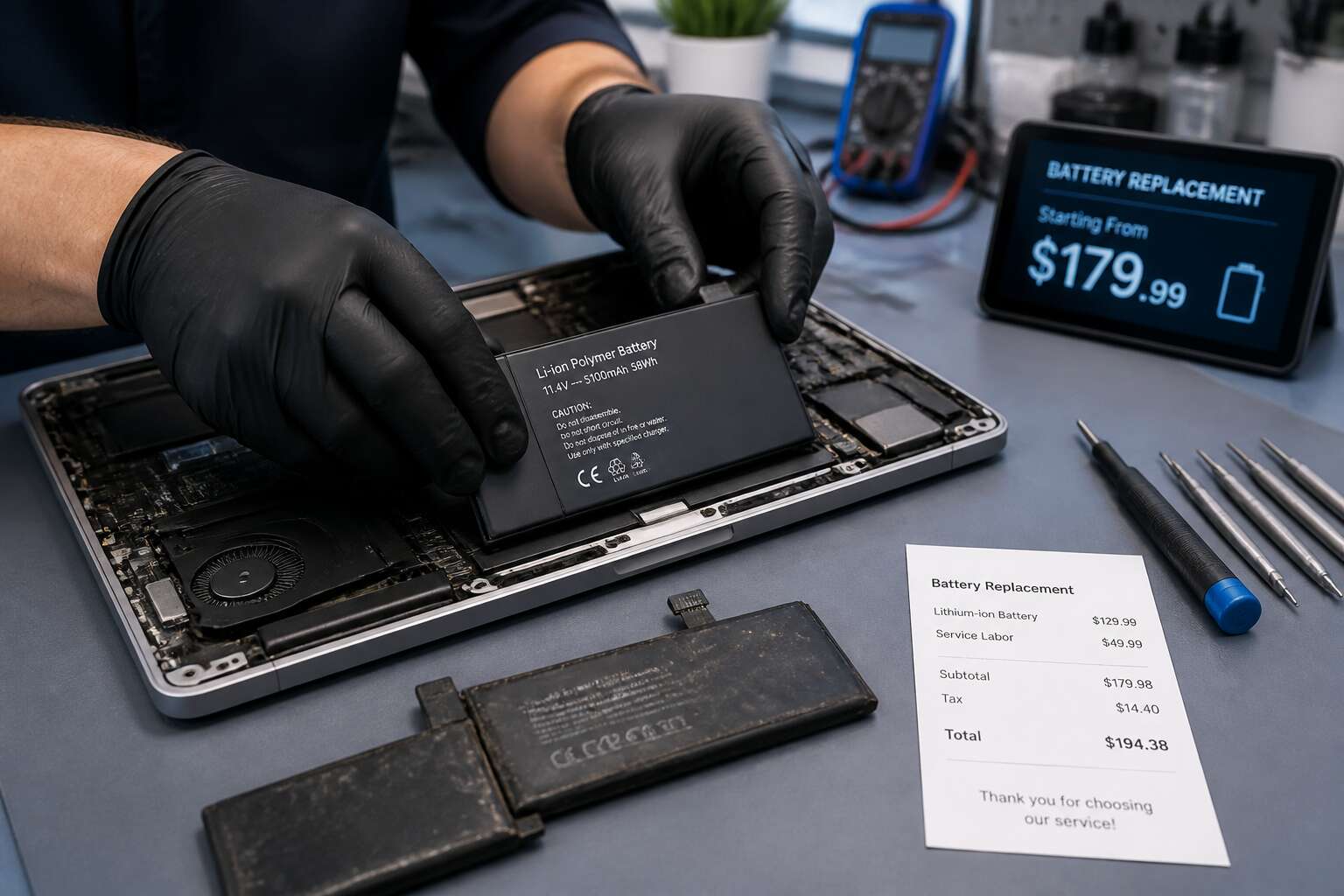
Key Cost Drivers Behind Battery Replacements
Impact of Laptop Brand and Model Rarity
Across South Africa, the laptop battery change price for two identical laptops can differ by hundreds of rands. The culprit is usually not the battery itself, but the brand’s control over its replacement ecosystem. The variance stems from official channels versus independent repair shops. A ThinkPad battery might set you back a modest R600; a niche gaming laptop’s proprietary cell can approach R2,000.
Rarity drives this disparity. Older models often command higher quotes because suppliers discontinue stock. Import duties and shipping fees also nudge the final figure upward. Service centres in Johannesburg and Cape Town often quote different rates for the same replacement. Conversely, some laptops use batteries shared across a product family, which keeps costs lower.
- Premium brands like Dell XPS and MacBook Pro charge more for certified replacements.
- Budget laptops frequently have cheaper third-party alternatives.
- Discontinued or obscure models require special orders, inflating labour and freight.
The laptop battery change price, then, reflects supply chain bottlenecks and brand loyalty more than actual battery chemistry.
OEM vs Third-Party Battery Pricing
OEM cells carry a premium because certification and warranty add to their cost. A genuine HP battery for a Pavilion can cost R1,400, while a compatible equivalent sits near R450. The laptop battery change price often depends on which route you choose.
In my experience, third-party options vary in quality. Some manufacturers use recycled cells or weaker controllers, which shorten lifespan. Others produce solid alternatives for older models where OEM stock is discontinued. For popular laptops, competition keeps prices low.
- OEM pricing includes brand testing and logistics
- Third-party pricing reflects market competition
Shipping from overseas adds R200 to R350 to either option. Local stock reduces that cost. The laptop battery change price depends on availability more than the battery’s actual components.
Labor Fees at Authorized Repair Shops
Labor fees often exceed the cost of the cell itself. At authorized shops in Johannesburg, I have seen hourly rates from R350 to R600. The total bill can double before the technician opens the chassis! Diagnostics alone can take 30 minutes. Genuine calibration and power-cycle tests add another hour.
Several forces drive these fees upward:
- Authorized technicians must follow manufacturer procedures.
- Proprietary tools and software licenses are not cheap.
- Insurance and rent in shopping centres factor into the rate.
Even simple swaps take 45 minutes when screws, clips, and adhesives are handled properly. The laptop battery change price includes that labour alongside the component cost.
Additional Replacement Parts and Tools
Quoted prices for a laptop battery change price often exclude the incidental hardware that surfaces during the repair. Technicians need replacement screws when factory threads strip, adhesive strips for resealing, and new ribbon cables if old ones crack during removal. Some laptops also require thermal paste when the heat pipe sits directly over the battery bay.
These extras accumulate quietly:
- Adhesive mounts and pull tabs, typically R50 to R120 per set
- Replacement screws or full bottom cover kits
- Thermal pads for components near the battery
- Proprietary connectors if a vendor locks the cell in place
Each addition pushes the laptop battery change price upward, often by R200 to R500 before labour enters the figure.
Typical Price Ranges by Laptop Segment
Budget Notebooks and Compact Chromebooks
Few people notice their battery’s slow decline until the laptop dies mid-sentence. For budget notebooks and compact Chromebooks, the laptop battery change price usually stays below R1,500. Entry level Acer and HP machines commonly cost R800 to R1,200. Chromebooks, whose sealed cases require careful prying, often land near the top of that range.
Quotes I’ve gathered from Johannesburg repair shops:
- Acer Aspire 3: R850 to R1,150
- HP Stream 11: R780 to R1,000
- Lenovo Chromebook 300e: R950 to R1,300
I’ve learned to ask what exactly the figure covers. A low quoted price often excludes the calibration and the final safety test. The laptop battery change price becomes honest only when the shop names every step in writing.
Mainstream Ultrabooks and Thin-and-Light Laptops
Mainstream ultrabooks and thin-and-light laptops hide their batteries deep inside sealed frames. Removing one requires careful heating and prying, which is why repair shops quote conservatively.
From Johannesburg to Cape Town, the laptop battery change price for these devices typically ranges from R2,000 to R3,500. The exact figure depends on the model’s layout and the battery’s capacity.
- Dell XPS 13: R2,200 to R2,800
- Lenovo Yoga 7: R2,000 to R2,600
- Asus ZenBook 14: R2,400 to R3,200
These quotes assume genuine parts and a full charge cycle test. Anything below R1,800 often means reused cells or skipped diagnostics.
High-Performance Gaming Laptops with Larger Batteries
Gaming laptops demand more from their batteries. Power-hungry components require larger cells, often 70Wh to 99Wh, tucked into thicker chassis that actually make replacement easier. The irony is that the bulkier design simplifies access.
In South Africa, the laptop battery change price for these machines typically starts around R2,500 and climbs to R4,500. The variance depends on capacity and whether the unit uses a removable panel or a screw-down base.
Some models make the job straightforward:
– ASUS ROG Strix G15: R2,800 to R3,400
– MSI Katana GF66: R2,500 to R3,200
– Acer Nitro 5: R2,600 to R3,600
The larger size does not guarantee a better deal. Certain gaming laptops from Dell and Lenovo require disconnecting the motherboard to free the battery connector. That labour pushes the final cost upward. Heat also shortens battery life here, which means you will face this laptop battery change price sooner than you expect, and you might be taken aback by the total!
Business Workstations and Proprietary Batteries
Business workstations rarely accept generic replacement cells. Their proprietary batteries carry embedded management chips and custom pin layouts. A standard retail battery will not even power on a ThinkPad P16. This forces owners to source parts through authorised channels. The laptop battery change price for workstation-class hardware often lands between R3,200 and R5,500. Some models offer a secondary internal battery. Others use a removable external pack:
– HP ZBook Fury: R3,500 to R4,800
– Dell Precision 7000 Series: R3,800 to R5,200
– Lenovo ThinkPad P15: R3,200 to R4,600
These systems also demand careful calibration after installation. Workstation users replace batteries for uptime and data safety. That need justifies a higher cost than a mainstream ultrabook, and the proprietary design removes any shortcut to a lower laptop battery change price.
Professional Service vs Do-It-Yourself Replacement
Breakdown of Service Center Charges
Rather than fixing a battery yourself, many owners discover that the laptop battery change price at a service center includes more than parts and effort. A typical breakdown starts with a diagnostic fee to measure battery health and detect other faults. Next is the battery cost with a service margin. Then labor charges vary with technicians’ expertise. Finally, some centers apply a disposal fee for old lithium cells.
- Diagnostic testing, R150 to R400
- Original or trusted third-party battery
- Labor time, often R300 to R800
- Recycling or e-waste handling
DIY replacement skips labor fees, but it leaves no warranty for installation errors. Service centers validate firmware updates and charge for that certainty.
Hidden Expenses in DIY Replacements
You saved the labor fee, but did you budget for the screwdriver set you will never use again, the plastic clips you snap, and the online guide that tells you to repeat step 14? DIY battery swaps expose hidden costs that never appear on a service center invoice. A stripped screw, a torn ribbon cable, or a static shock can turn an R800 battery into a R4,000 motherboard repair.
The laptop battery change price at a shop looks steep because it includes accountability. When you DIY, you become the technician, the quality control department, and the warranty provider. One wrong firmware update, and your new battery is useless. Let’s tally the common extras:
- Specialized tools, from plastic spudgers to magnetic trays
- Replacement adhesive or thermal paste
- Shipping fees for a second battery after the first arrives dead
- Emergency repair costs when things fail
Warranty Coverage and Void Risks
A single stripped screw can nullify a three year warranty. Professional service centers employ technicians who understand the delicate balance between repair access and manufacturer seals. Their work is documented, serialized, and traceable. Every rand you spend on a laptop battery change price includes that paper trail.
DIY replacements carry no such assurance. You assume the role of warrantor, and manufacturers often reject claims once they detect third party intervention. Static discharge, a bent connector, or an unseated cable can brick your machine with no recourse.
- Portable computer and component warranties expire when unofficial repairs are performed.
- Defective replacement batteries are rarely covered by the original manufacturer.
- Future service claims, even on unrelated hardware, face intense scrutiny.
An authorized shop absorbs these liabilities. The premium you pay is protection against your own mistakes.
Safety Concerns with Adhesive-Backed Batteries
Modern ultrabooks secure batteries with industrial grade adhesive strips. Prying a swollen cell from a magnesium chassis is not a gentle task. One slip with a metal spudger can puncture the lithium pouch, releasing flammable electrolytes. The resulting thermal event is sudden, violent, and completely uninsurable under a home policy.
Professional technicians apply isopropyl alcohol formulations and controlled heat to soften the bond. They understand the pressure points of each chassis generation. This expertise is why the laptop battery change price at a service centre includes liability coverage that a kitchen table repair never will. The quoted laptop battery change price also covers proper disposal of the old cell, something municipalities in South Africa rarely accept from individuals.
- Solvent fumes require proper ventilation
- Distorted cells demand specialised containment
- Adhesive residue must be fully removed to prevent pressure points
DIY guides rarely mention these variables. Your R200 savings could easily become a R15,000 replacement cycle.
Time and Convenience Trade-Offs
Time operates differently for each person. A DIY battery swap on a mainstream ultrabook might take 40 minutes when the adhesive behaves, or it might consume a full Saturday when the cell resists every plastic spudger. That timeframe assumes you own the correct tools and have sourced a compatible battery first. I have watched such sessions stretch well past midnight.
Professional technicians complete the same procedure while you wait. The laptop battery change price includes their familiarity with common chassis designs, their heating equipment, and their ability to diagnose a swollen cell before it damages the trackpad cable. You collect your machine the same afternoon.
Weigh your schedule realistically:
- Waiting for a battery delivery from a local supplier
- Returning an incorrect order to an online store
- Cleaning adhesive residue after a failed attempt
Each task quietly consumes hours. The laptop battery change price at a service centre is often less about the labour itself and more about buying back your time and certainty.
Strategies for Securing the Most Competitive Pricing
Requesting Multiple Quotes and Price Matching
The same laptop battery change price can swing from R500 to R1,500 in the same city, on the same day. I have seen it happen. The gap is rarely about quality. It is about who you talk to and how you ask. One vendor quoted R1,200 for a third-party unit. Two blocks away, another shop offered the same part for R750!
Requesting multiple quotes is the first step. Email is fine, but a phone call gets you a firmer answer. Ask for the total cost, parts and labour included. Then take that figure to a second shop. Many repair centres will match a written quote if it is recent and from a local competitor. They would rather keep your business than watch you walk out.
To keep the laptop battery change price in your favour:
- Get three written estimates before committing
- Ask if the shop price matches local competitors
- Present the lowest quote as leverage, politely
- Confirm the final amount before any work begins
This approach takes an afternoon. It saves money almost every time.
Comparing Online Marketplaces and Physical Stores
Online marketplaces flaunt tempting laptop battery change price tags, yet shipping fees and waiting periods muddy the final cost. A physical store lets you inspect the unit before paying, and the technician can verify compatibility on the spot. E-commerce sellers occasionally list refurbished cells as new, a discovery that surfaces only after installation. Local shops carry overheads that push quotes higher, but they offer immediate replacement and direct recourse. The prudent shopper compares both channels:
- Total delivered cost, not just the listed price
- Return policies and warranty coverage
- Whether the seller confirms your exact battery model
The cheapest listing rarely wins once these factors enter the equation.
Timing Purchases Around Sales Events
Timing remains the quiet lever in battery replacement economics. In South Africa, retail cycles follow predictable rhythms. Black Friday discounts often extend into Cyber Monday, and January brings back-to-school promotions that include laptop accessories and spare parts. During these windows, the laptop battery change price can shift downward, especially for popular notebook models.
Retailers also use mid-year clearance sales to move older inventory. Battery stock moves quickly, and popular models for mainstream laptops vanish within hours. A buyer who monitors pricing trends across several weeks gains a useful sense of the normal range before sales events begin.
Keep an eye on these periods:
– Black Friday and Cyber Monday in late November
– January back-to-school sales
– Mid-year winter clearance sales
Each window carries uncertainty. Supply shortages can push prices upward despite the season, so flexibility with timing matters as much as the event itself.
Using Price Tracking Tools and Alerts
The best laptop battery change price is rarely visible to the casual shopper. It hides behind fluctuating stock levels and regional demand. Price tracking tools pull back the curtain. In South Africa, services like PriceCheck and browser extensions for Takealot track components with surgical precision. Set an alert for your exact laptop model. The tool does the watching for you.
Consider these tactics to stay ahead:
- Use price history charts to spot genuine drops versus marketing noise
- Set alerts for both OEM and third party battery listings
- Check multiple retailers in one dashboard
Patience becomes strategic. A laptop battery change price that sits high today often corrects within weeks. You wait for the signal, not the season.
Checking for Student or Corporate Discounts
Most people never ask for a discount on a laptop battery change price. They accept the quoted figure as if it were fixed in stone. In South Africa, universities and large employers often hold corporate accounts with major tech retailers and repair chains. Those accounts carry negotiated rates that are never advertised to the public.
If you are a student, your institutional email address may unlock vendor pricing portals. If you work for a company with an IT procurement department, ask them to source the battery through their supplier network. You might pay wholesale instead of retail.
- Check your university’s IT or student benefits page for hardware discounts
- Ask your HR department about employee purchase programmes
- Contact the repair shop directly and mention your institutional affiliation
These avenues require a few minutes of effort, but they can lower the laptop battery change price considerably.
Evaluating Extended Service Plans and Warranties
No repair shop displays extended warranty terms next to the price list. Those agreements shift risk to the customer and can reshape the laptop battery change price. A plan covering battery degradation for three years might justify a higher upfront cost, while one that excludes wear and tear offers little protection.
To secure competitive pricing, I ask whether the labour fee is flexible when the battery comes from their own stock! Some Johannesburg technicians shave a few hundred rand off the labour charge for a weekday booking. Others drop the total when you decline express turnaround.
- Ask about refurbished batteries, as they can lower the laptop battery change price.
- Confirm whether the quoted amount includes a workmanship warranty.
Read every clause in the extended plan. Some contracts require an authorised centre, which may charge premium rates that offset the coverage. Compare the annual premium against the battery’s expected lifespan before signing.
Diagnostic Clues That a New Battery Is Needed
Abrupt Shutdowns Below 30 Percent Charge
Your battery’s dying breath is rarely a gentle fade. It is often a sudden, violent severance from the session you were working on. A complete shutdown at 28 percent charge is not a software quirk. It is a primal scream from a cell that can no longer hold its chemical energy. This behaviour signals the end of your battery’s functional life and the beginning of your research into the laptop battery change price.
When the charge indicator lies to you, you are dealing with faulty metering. The battery reports a healthy reserve, yet the voltage collapses under a modest load. This leads to abrupt power loss, often before the operating system can even register a warning. You might also notice the device feels unusually warm near the base, even when idle. Other telltale signs include:
- Swelling or deformation of the laptop’s bottom casing
- A persistent “battery health” warning from the BIOS
- Significant runtime drops, such as losing 50 percent capacity in under an hour
Each instance pushes you closer to confronting the inevitable laptop battery change price. The cost of urgency, however, is often higher than the cost of planning. A battery that dies at 30 percent today will die at 60 percent tomorrow. The degradation is not linear. It accelerates with every forced discharge cycle.
You may be tempted to run diagnostics or recalibrate the battery by draining it completely. Do not do this. Forcing a deep discharge on a failing cell risks permanent damage to the laptop’s power management circuitry. The repair then shifts from a simple component swap to a motherboard-level intervention, multiplying your laptop battery change price several times over. The market for replacement cells in South Africa is robust, but the price varies with the severity of the neglect you have shown your machine.
Battery Swelling or Visible Deformation
Swelling is the battery’s final physical declaration. A failed lithium cell produces gas internally, and the pressure distorts the laptop’s frame. The trackpad loses its click response. The bottom casing reveals a subtle seam. If the chassis bows upward near the palm rest, the battery is a hazard.
Visible deformation demands immediate attention. Pressing the swelling panel to test it is futile. Charging the device is dangerous. The cell is rupturing internally, and each charge cycle increases the risk of a thermal event.
Once swelling is confirmed, the laptop battery change price becomes a secondary concern, because a swollen pack is beyond repair. The device must be isolated from anything flammable, and a qualified technician is the only safe contact point. A swollen battery cannot be drained safely, and disposal requires handling protocols. South African repair quotes for this scenario factor hazardous waste legislation into the laptop battery change price.
Performance Degradation After Two Years of Use
After two years of daily charging, the laptop battery begins to reveal its true feelings. The system report shows a maximum capacity that has quietly slipped below 80 percent of the original design, and the estimated time remaining swings wildly during ordinary tasks. The laptop battery change price becomes a relevant number once the device requires a charger before lunch.
Several indicators confirm the diagnosis without specialist tools. The charging speed drops noticeably once the battery reaches 80 percent, the underside runs warm during video calls, and the battery percentage falls in clumps rather than a smooth curve. Each points toward rising internal resistance.
For a South African user, the practical effect is simple. A laptop that once ran a full day now needs its charger by mid afternoon. The laptop battery change price starts to look like a sensible figure when the alternative is being permanently tethered to a wall socket.
Interpretation of Built-In Health Report Utilities
Built in health report utilities turn guesswork into measurable data. Windows users generate a battery report through the command prompt, while macOS owners check the system report under power settings. Linux offers tools like upower for similar diagnostics. These utilities compare current maximum capacity against design capacity, revealing wear levels with precision.
- Design capacity versus full charge capacity
- Cycle count and charge/discharge history
- Estimated runtime based on current draw
Interpreting these numbers requires context. A battery reporting 78 percent of original capacity will struggle during high load tasks, even if the health status still says normal. The laptop battery change price becomes easier to justify when the utility confirms a steady downward trend across multiple readings. Quarterly checks reveal patterns that single readings miss, giving South African users a clear picture of whether replacement is genuinely necessary.



0 Comments